
The "Butter Effect" And Why a Consumer Marketing Matters to B2B Growth Strategy
- Apr 22
- 3 min read
At first glance, the “butter effect” sounds like another fleeting internet trend. Aesthetic kitchen counters, vintage cookware, cozy routines, analog hobbies, oversized sweatshirts, and content built around slower, simpler living.
It would be easy for B2B leaders to dismiss it as irrelevant. That would be a mistake.
Because the butter effect is not really about butter. It is about buyer psychology. And buyer psychology influences every market.
Let's unpack what it is really quick: A D2C marketing trend we picked up on in 2025-2026 where influencers and engagement on social significantly spiked on content around nostalgia (specifically aesthetics, decor, and food from the 90s).
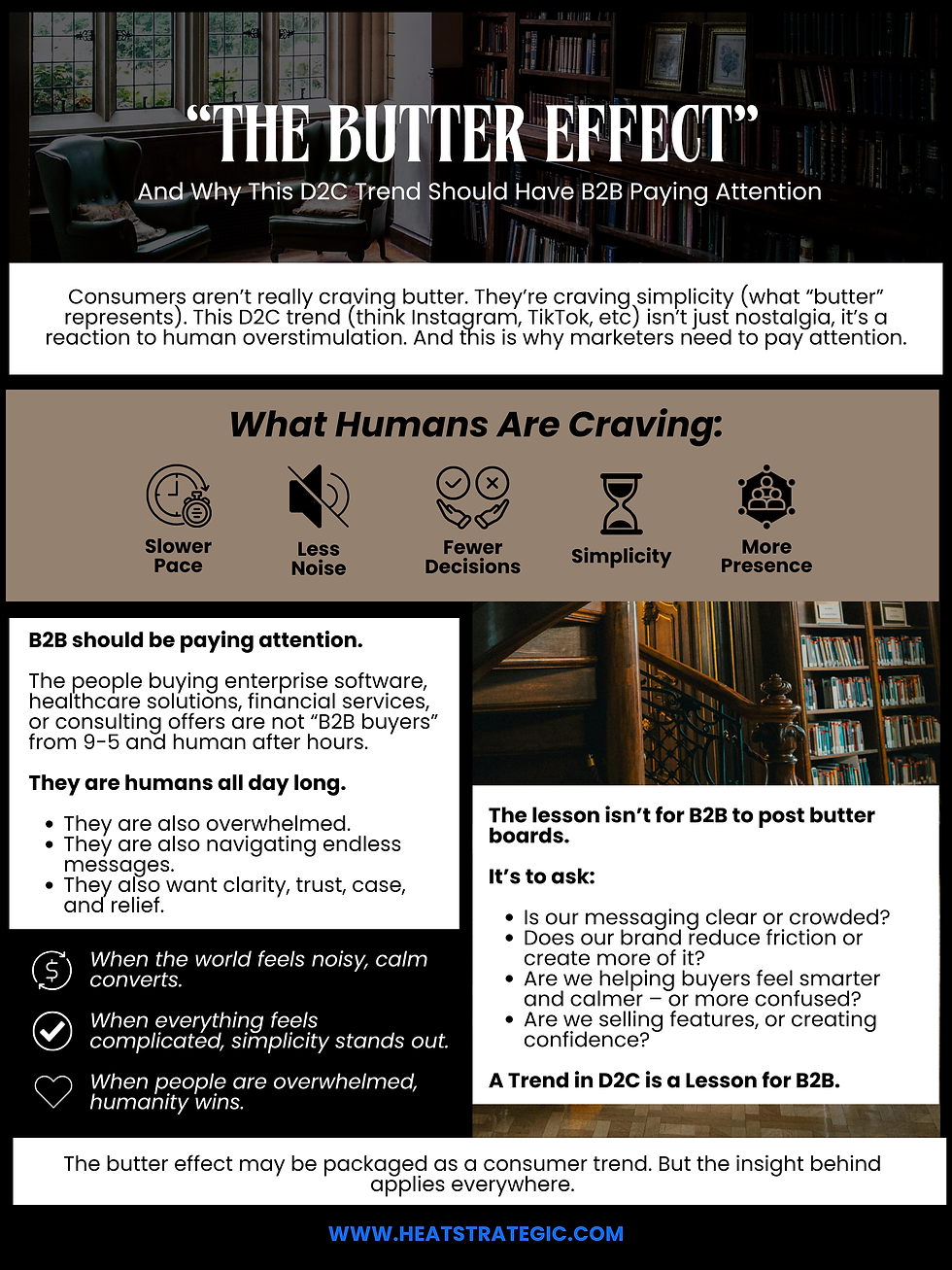
What the Butter Effect Actually Represents
Consumers are not suddenly obsessed with dairy. They are responding to what butter symbolizes in an increasingly overstimulated world:
A slower pace
Less noise
Simplicity
Fewer decisions
More presence
A sense of ease
In a landscape defined by constant notifications, algorithmic feeds, economic uncertainty, and endless choices, simplicity feels luxurious. Calm feels valuable. Familiarity feels safe.
This is less about nostalgia and more about relief.
Why B2B Should Be Paying Attention
Too often, B2B companies separate business buyers from human behavior. They assume the person purchasing enterprise software, healthcare solutions, consulting services, or financial products operates on pure logic during work hours and emotion only after hours.
That is not how people work.
Your buyers are still human at 10 a.m. on a Tuesday. They are still overwhelmed by too many messages. They are still navigating pressure, risk, and decision fatigue. They still want to feel confident in the choices they make.
The companies that understand this build marketing that meets people where they are emotionally, not just functionally.
What This Means for Your Marketing Strategy
The lesson is not to chase consumer aesthetics or suddenly turn your LinkedIn page into a lifestyle brand.
The lesson is to remove friction.
Ask yourself:
Is Our Messaging Clear or Crowded?
Many brands mistake complexity for sophistication. In reality, crowded messaging often signals internal confusion. If prospects need too much effort to understand what you do, they move on.
Does Our Brand Reduce Anxiety or Add to It?
Every buying decision carries risk. Strong brands reduce uncertainty through clarity, consistency, and trust signals. Weak brands create more questions than answers.
Are We Selling Features or Creating Confidence?
Features matter. Outcomes matter more. Buyers want to know your solution works, fits their world, and will make them look smart for choosing it.
Are We Easy to Buy From?
Sometimes the issue is not demand generation. It is unnecessary friction in the journey. Too many steps, unclear next actions, jargon-heavy copy, disconnected follow-up, or bloated decision processes can quietly kill momentum.
Why Simplicity Wins in Noisy Markets
When markets become saturated, many companies respond by getting louder. More campaigns.
More messaging. More channels. More content.
But volume is not the same as effectiveness.
The brands gaining attention today often do the opposite:
They communicate simply
They position clearly
They make decisions easier
They build trust quickly
They create a sense of calm in a crowded category
When the world feels noisy, calm converts.When everything feels complicated, simplicity stands out.When buyers feel overwhelmed, humanity wins.
The Strategic Opportunity for Growth Leaders
For founders, CMOs, and revenue leaders, the butter effect is a reminder to look beneath surface trends. The real signal is rarely the aesthetic. It is the unmet need driving it.
Right now, that need is clarity.
Brands that can deliver clarity in their positioning, confidence in their process, and ease in their buyer experience will outperform those still relying on noise and feature overload.
Final Thought
The butter effect may be packaged as a D2C trend, but the insight behind it applies everywhere.
Whether B2C or B2B, every buying decision is still made by a human being.
And in a world asking people to process more than ever, the brands that simplify will be the brands that grow.


Comments